
Connections & Relationships
Distance and Living Arrangements
Where grandparents live in relation to their grandchildren is one of the strongest factors shaping how relationships unfold.
Grandparents’ proximity to all their grandchildren ranges from shared households to long-distance, and these distance patterns shift with age.
Proximity to grandchildren
Percent of grandparents with grandchildren who are…
Same household
Local (Less than 10 miles, including same household)
Mid-distance (11–50 miles)
Long-distance (more than 50 miles)
Living arrangements vary, and proximity often allows for more daily sharing of stories, routines, values, and traditions.
Beyond the 11% of grandparents who currently live in the same household as at least one grandchild, more grandparents have shared a home with grandchild(ren) at some point within the past year.
Grandparent living arrangements with grandchildren
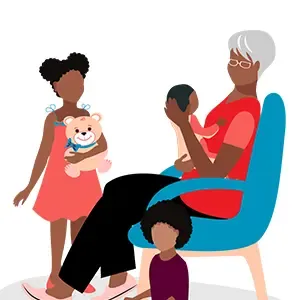
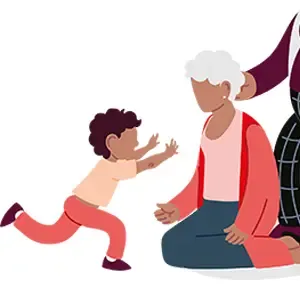


Grandparents who share a home (long-term or temporarily) with grandchildren report significantly higher fulfillment, satisfaction, and joy in their grandparenting experience, but also significantly more challenge (20% vs. 8% of those living independently):
- Fulfillment (very or extremely): 84% vs. 77%
- Satisfaction (very or extremely): 84% vs. 72%
- Joy (all-encompassing or a lot): 88% vs. 81%
One in ten (10%) grandparents serve as primary caregivers for their grandchildren, meaning they are the legal guardian or person solely responsible for their care. Among all long-term co-resident grandparents, 44% say they or their spouse hold this responsibility. The data suggests this is much more common among grandparents under age 50 living with grandchild(ren) long-term, although they represent a minority share.
Multigenerational family living arrangements are also shaped by cultural norms, and the prevalence of multigenerational households differs across racial and ethnic groups of grandparents. We define multigenerational living in this study as a household that includes a grandparent, the grandparent’s own child(ren) or the grandchildren’s parent(s), and grandchild(ren).
28% of grandparents lived together with a grandchild at any point in the past year, whether permanently (13%), short term (14%), or for an unknown duration (1%).
- Out of them, 15% also live with the grandchild’s parent(s) or their own children (multigenerational living).
Separately:
- 11% live together now (at the time of the survey).
Grandparents who live in multigenerational households
Staying Connected
Proximity provides the opportunity, but interaction frequency is what turns opportunity into lived connection. Many grandparents are using digital modes to stay close.
Contact frequency tracks closely with distance: as distance increases, all forms of contact decline, not just in-person visits. For example, among those with grandchildren living 500 miles away or more, 16% say they stay in touch through phone, text, mail, and other non-in-person contact infrequently—compared to only 4% for those with grandchildren living within a mile.
In a clear sign of modern family life, digital communication now anchors many grandparent–grandchild relationships. Three-quarters of grandparents (76%) say electronic technology like texting and video calls, social media, shared photo apps, email, group chats, and shared calendars are a primary way they stay connected. Texting is a particularly important way in which older grandparents stay in touch: fully half (50%) of grandparents 80-plus text with their grandchildren.
At the same time, how grandparents stay connected is shaped in part by the ages of the grandchildren with whom they are communicating. Younger grandparents (35 to 49), who are most likely to have grandchildren too young for their own devices, rely more heavily on video calls as a way to stay in touch. Those 50 to 64, whose grandchildren increasingly span school age and adolescence, use a mix of texting and video calling. And older grandparents, whose grandchildren are more likely to be teens and adults with their own communication preferences, connect primarily through texting, email, and phone calls. In-person visits and phone calls remain foundational across all age groups, but the digital toolkit shifts as grandchildren grow into their own modes of staying in touch.
As one grandfather in his 50s reflected, “I feel most connected with my grandkids when I get to see them on FaceTime and it’s unexpected…it brightens you up.”
Most common ways grandparents stay in touch
Total and by age range
Total
Age 35–49
Age 50–59
Age 60–69
Age 70–79
Age 80+
Barriers and Contributors to Fulfillment
When grandparents describe what makes their experience fulfilling or what detracts from it, clear themes emerge. To make sense of these patterns, we grouped related responses into clusters that grandparents tend to select together, identifying three factors that contribute to fulfillment in grandparenting and five that detract from it.
The contributing factors suggest that fulfillment most often comes from supportive family dynamics, presence and time together, and clarity and ease in how the role fits into everyday family life.
Contributors to fulfillment
Percent of grandparents mentioning each contributor
Relationship harmony & feeling valued
Proximity & in-person closeness
Alignment & low-friction coordination
Detractors split into distinct barrier types, from access constraints to role friction to personal capacity limits.
Barriers to fulfillment
Percent of grandparents mentioning each barrier
Family conflict & relationship challenges
Distance & reduced connection
Role tension & boundary uncertainty
Caregiving strain & capacity limits
Logistical mismatch (schedules & life stage)
Health and Well-being Impact
Most surveyed grandparents express strongly positive views of their mental and physical health. These self-assessments mirror broader national patterns, with older adults commonly reporting positive physical, mental, cognitive, and social well-being.
Time with grandchildren builds on this foundation. While most grandparents do not engage with grandchildren for health reasons, many derive emotional and cognitive benefits from these relationships.
My husband used to call them [the grandchildren] his vitamins…Instead of taking vitamins, all he had to do was look at them, and that was it.
- Grandmother in her 80s
Younger grandparents (35-64) are significantly more likely to report these benefits. Importantly, older grandparents do not report greater negative health impacts; their lower perceived benefits reflect reduced gain, not increased harm.
Health benefits of grandparenting
Percent who say time spent with their grandchildren has improved their…
Relationship Styles
There are many distinct ways to approach grandparent-grandchild relationships. Because of this wide variation and the lack of a shared norm, scholars have called being a grandparent a “roleless role.” Likewise, our analysis finds grandparents show up in variety of patterns: nine typologies emerge when role identities (how grandparents say they show up) are considered alongside intergenerational exchanges (whether grandparents teach, grandchildren teach, or the intergenerational learning is mutual). These typologies can be thought of as relationship styles shaped by life stage, opportunity, and circumstance—and they highlight that grandparents need different information based on how they show up and connect.
Some grandparents think of themselves as guides or teachers for their grandchildren, such as Robert, a grandfather in his 50s who falls in the ‘Guiding Teachers’ typology: “I like to mentor my grandkids. I like to lead by example, so it’s important to me for them to get to know us as grandparents.”
Others focus more on mutual enrichment, like Carol, a grandmother in her 70s who falls in the ‘All-In Engagers’ typology: “It makes me the most happy when they want to share something that’s important to them. And it might be something very outside of my realm, but it’s okay. It’s that they’re actually sharing that with us.”
Grandparenting typologies
Percent of grandparents in parentheses
In the table below, typologies are ordered from most constrained relationship exchange patterns to the most expansive and reciprocal. Select a typology to learn more about how they relate to their grandchildren.